EPD or LCA?
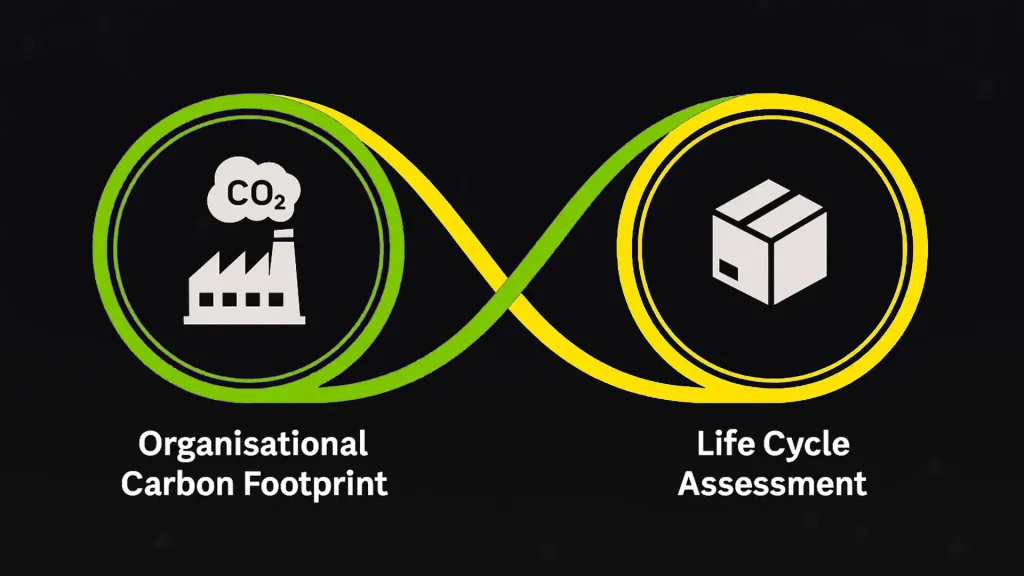
This article also helps clarify when EPDs are worth it, and when another approach, like an LCA, may be more appropriate. Environmental Product Declarations (EPDs) have gone from niche documents to something many teams now run into every day. Whether you work in construction, architecture, product design, manufacturing, or procurement. They sit on top of a Life Cycle Assessment (LCA), but the two do very different jobs.
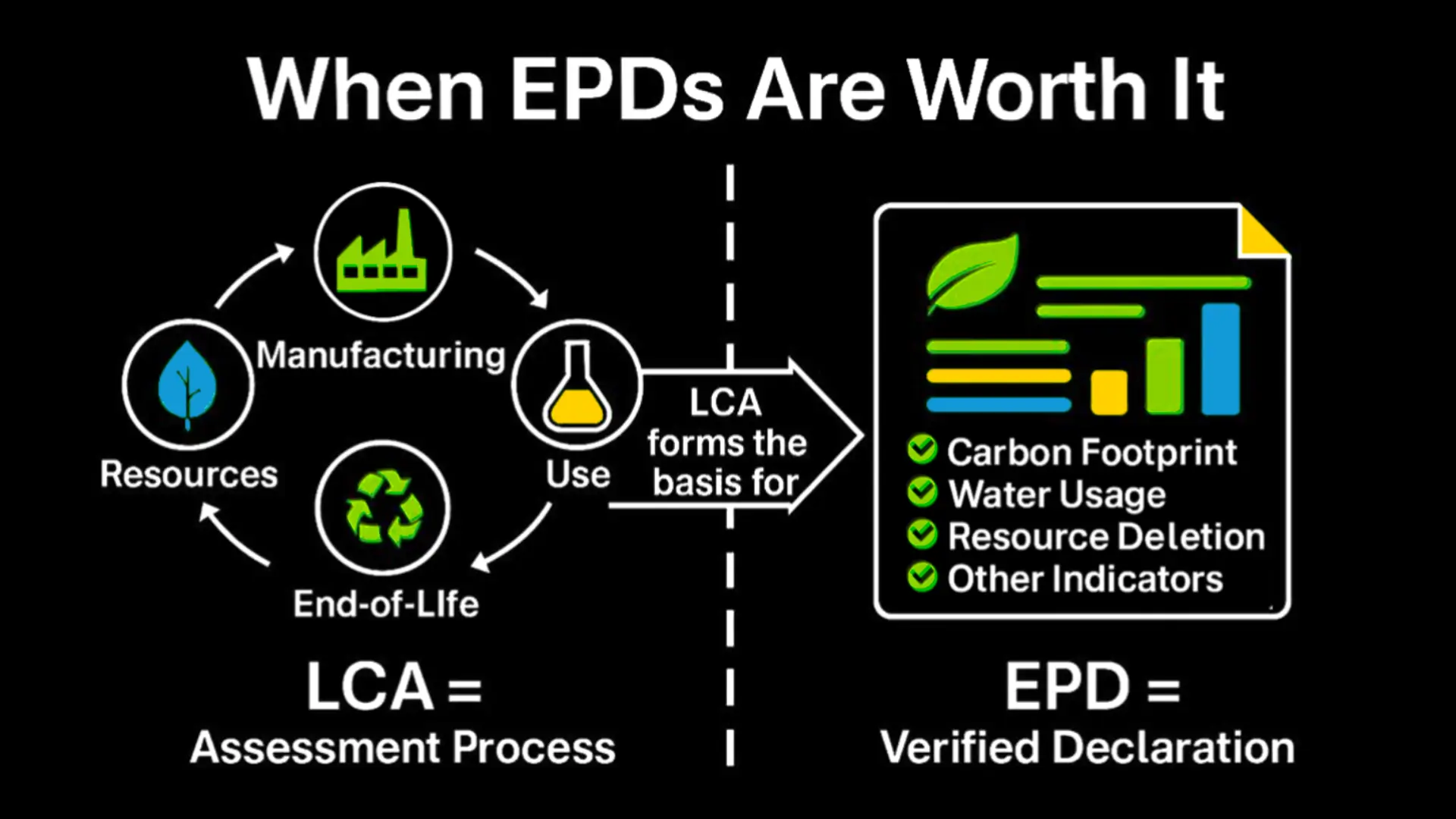
If the LCA is the technical engine, the EPD is the dashboard: structured, verified, and built for comparison.
EPDs aren’t always the answer. But in the right context, they can be incredibly powerful tools for transparency, market access, and credibility. This article walks through what EPDs actually do, how they differ from LCAs, when they’re worth the investment, and when you might not need one yet.
What an EPD actually is
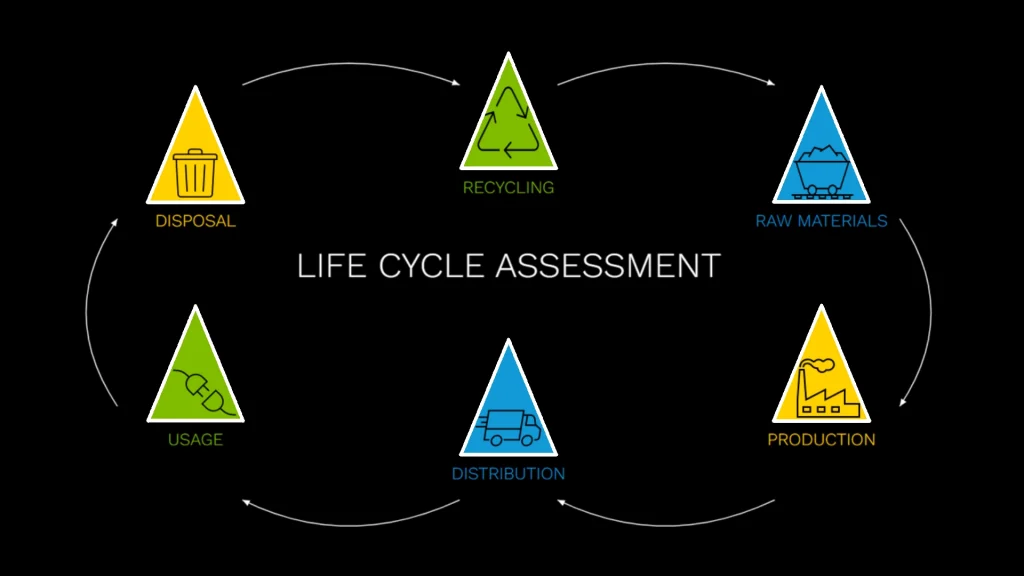
An EPD is a third-party verified document that communicates a product’s quantified environmental impacts across its life cycle. It usually covers raw material extraction, manufacturing, transport, use, and end-of-life, though the exact boundaries depend on the rules set for that specific product category.
Those rules matter. EPDs follow standards such as ISO 14025 (Type III environmental declarations) and category-specific frameworks like EN 15804 (for construction products) or ISO 21930 (for building materials). Within each category, you’ll find Product Category Rules (PCRs) — and they’re essential. PCRs dictate what needs to be measured, how it must be calculated, and how results should be reported.
They’re the reason two insulation products or two types of concrete can be compared fairly. Without PCRs, every manufacturer could choose their own method, and comparisons would fall apart.
It’s also important to say what an EPD is not: it is not an environmental label or a “green badge.” It doesn’t claim the product is sustainable. It simply reports impacts (from global warming potential (GWP) to acidification and resource use) in a consistent, transparent format.
The backbone: the key elements of a compliant EPD
Every EPD, regardless of product type, has to meet a set of standard requirements defined by the relevant PCR. While the details differ, the foundations are always similar.
There needs to be clarity on what’s being declared: typically a “declared unit” such as one square metre of a material, or one piece of a finished product. The system boundary also has to be defined: which stages of the life cycle are included, and how they are reported.
Next comes data quality. Program operators expect clear information on where data comes from, how recent it is, how allocation was handled, and how any assumptions were made. Impact categories must follow the list defined in the PCR, and the calculations must follow agreed methods.
Finally, a verifier reviews everything (the data, the modelling, and the final document) before the EPD is allowed to be published.
This verification step is one of the reasons EPDs carry so much weight with buyers and certifiers. It signals that the methods, boundaries, and numbers have all been checked by an independent expert.
EPD vs LCA: different tools for different jobs
This is where teams often get confused, because the two are tightly connected but not interchangeable.
An LCA is the analytical method used to measure environmental impacts. It’s flexible, customisable, and incredibly useful for design decisions, early-stage development, and internal improvement work. LCAs can explore scenarios, test “what if?” questions, and run sensitivity analyses. They don’t need to follow a strict template, because they’re not necessarily meant for public consumption.
An EPD, on the other hand, is a structured, standardised, verified disclosure built on top of an LCA. Its job is communication: making impacts comparable, credible, and digestible for external stakeholders.
In simple terms:
You usually need an LCA to create an EPD. But you don’t always need an EPD if your goal is internal learning. This distinction becomes important when considering when EPDs are worth it.
When EPDs are worth it
These situations often highlight when EPDs are worth it and when they offer clear advantages over relying on an LCA alone.
1. When buyers need to compare products fairly
This is one of the strongest arguments for EPDs. When procurement teams need to compare two similar products, EPDs provide a level playing field. The PCR ensures that manufacturers use the same rules, boundaries, and methods. That consistency builds trust and reduces the risk of “creative accounting.”
It’s particularly useful in competitive tenders, large construction projects, and supplier pre-qualification, where the ability to benchmark products quickly and confidently matters.
2. When your audience needs verification
Third-party verification gives EPDs a credibility boost that self-declared claims simply can’t match.
Clients, auditors, green building certifiers, they all value verified data. For industries where ESG scrutiny is high, having an EPD makes environmental claims easier to validate and defend.
3. When you need alignment with certification frameworks
Many green building systems, including BREEAM, LEED, and HQE, recognise or reward the use of product-specific EPDs. They often require them for embodied carbon calculations or offer credits for products with verified declarations. In these cases, an EPD isn’t just a “nice to have”; it becomes the most efficient route to compliance.
4. When regulations move toward transparency
More regions are adopting policies that reference EPDs, especially for construction materials and public procurement. These include embodied-carbon reporting schemes and “Buy Clean”-style initiatives. Where regulation expects a verified, standardised disclosure, an EPD is usually the right tool.
5. When you need a simple, credible way to communicate impacts
EPDs distil complex LCA data into a format that technical and non-technical audiences can understand. For many manufacturers, an EPD becomes a reliable asset for sales, marketing, and client conversations, especially when paired with clear interpretation guidance.
When an EPD might not be the right move (yet)
EPDs aren’t the answer to everything, and there are moments where an LCA without publication is smarter.
Early-stage design is one of them. If you’re testing variants, exploring materials, or modelling future scenarios, you don’t want to lock numbers into a verified declaration. You want freedom to experiment.
Sometimes there simply isn’t a good PCR available for your product. Without a robust PCR, an EPD loses its comparability and therefore its purpose. In that case, a tailored LCA or engagement in PCR development is usually the better path.
Data maturity also matters. If your processes are unstable, changing, or based on provisional supply chains, an EPD may freeze numbers that will be obsolete in a year. An internal LCA helps you stabilise practice first.
And then there are highly bespoke or custom-made products. For one-off items or short production runs, the effort of creating an EPD may not deliver meaningful market value as they are usually valid for 5 years. A well-explained LCA summary might be more appropriate.
In these cases, it becomes clearer when EPDs are worth it and when publishing one may not add value.
Why different teams care
Manufacturers
EPDs help meet customer requirements, differentiate products, and uncover operational improvements. They’re also a way to stay ahead of emerging embodied-carbon rules.
Designers and engineers
They get comparable data that helps with material selection, value engineering, and whole-building embodied-carbon calculations. The verification element also reduces risk in audit-heavy environments.
Procurement teams
They benefit from like-for-like comparison, transparent data, and better alignment with corporate climate targets, especially when Scope 3 reductions are on the agenda.
Misconceptions worth clearing up
A few misunderstandings come up often.
An EPD does not mean a product is low impact. It only reports the impacts. It doesn’t judge them. Comparisons are only meaningful when products share the same PCR, system boundaries, and declared unit.
Another common confusion involves Module D, which reports benefits beyond the system boundary. It doesn’t always reduce the overall impact; context matters.
And finally, a generic or industry-average EPD isn’t the same as a product-specific one. Averages are useful early on, but they don’t reflect the performance of a specific product and usually score lower in certification frameworks.
A practical roadmap for getting started
Most organisations follow a similar sequence. First, they clarify why they need an EPD. That goal determines whether an LCA is enough, or whether a verified declaration is the right next step.
Then they review the PCR landscape to make sure the category rules exist and are appropriate. From there, the work shifts to data collection, especially around energy use, materials, waste, and transport. Supplier engagement at this stage is key.
Choosing the right LCA practitioner and program operator also saves time later in the process. Once the modelling is done, teams usually explore scenarios and improvement options before numbers are locked in. Only then does verification begin. After publication, the EPD becomes a tool that feeds continuous improvement and informs future updates.
The bottom line
EPDs shine when transparency, comparability, and credibility matter, especially in markets where buyers need consistent information or where regulation and certification frameworks push in that direction.
But they’re not always the first step. If you’re in early design, lack a suitable PCR, or need flexibility, a tailored LCA can give you the insight you need without the commitment of verification.
Most organisations end up needing both.
Use LCAs to learn and improve.
Use EPDs to communicate and prove.
And if you need support, whether it’s LCA modelling, EPD development, or navigating PCR requirements, Aria Sustainability can help you move quickly, confidently, and with the right level of rigour.