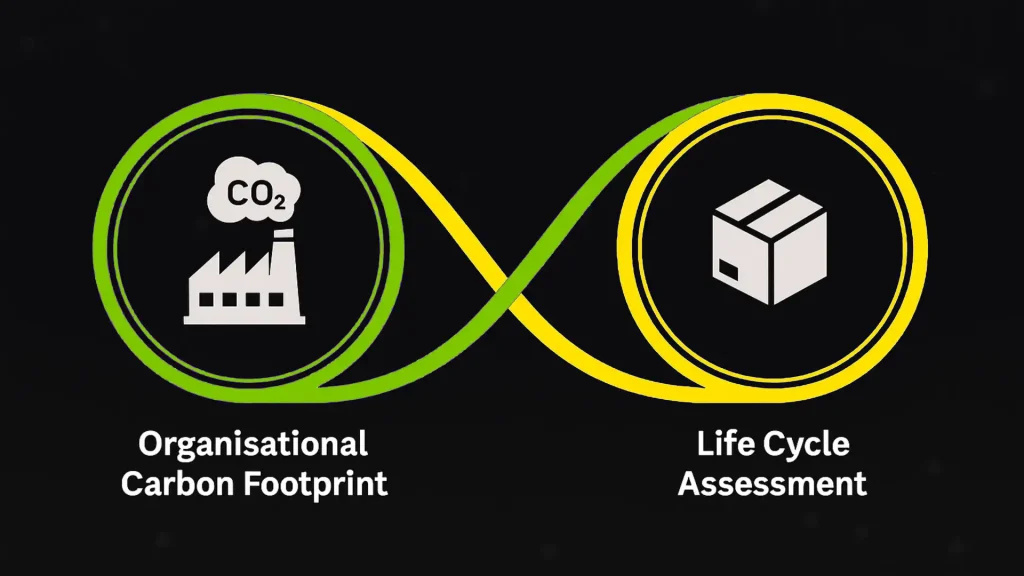
You might need a company carbon footprint because a customer has asked for your emissions data, a tender requires it, or you want a reliable baseline before deciding what to reduce.
Your first instinct might be to start collecting energy bills, travel records and spreadsheets from across the business. But before you do that, it’s worth understanding what the footprint needs to cover and what you’ll use the result for. This will help you work out which data you actually need.
To calculate a company carbon footprint, you will normally need activity data covering the emissions sources included within your reporting boundary. This could include electricity and fuel use, company vehicles, refrigerants, purchased materials, freight, business travel, waste and other value chain activities.
You do not necessarily need perfect data for everything before you start. You do need a clear boundary, a consistent reporting period and enough information to understand which activities are likely to account for most of your emissions.
First, define what you are measuring
Before asking different teams for data, start by clarifying what your carbon footprint needs to cover. Ask yourself a few basic questions.
- Which part of the business are you measuring?
One legal entity, one site, a UK operation or the wider group? - What period will your footprint cover?
Usually a financial or calendar year. - Which emissions do you need to include?
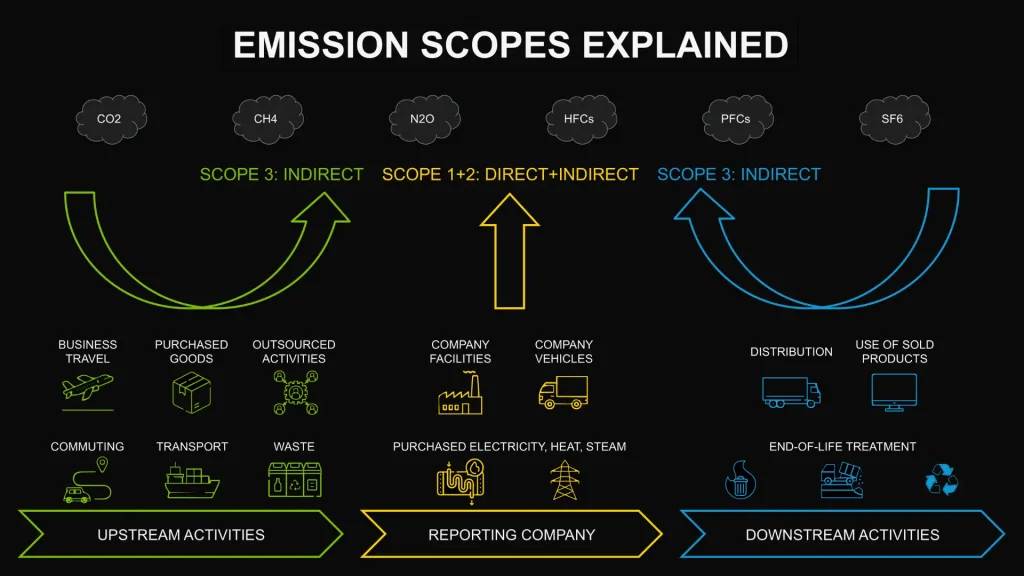
Do you need Scope 1 and Scope 2 only, or a wider Scope 3 inventory? - What will you use the footprint for?
Is it for internal decision making, a customer request, a tender, target setting or a reporting requirement?
These decisions matter because the same business can need different levels of carbon data for different purposes. If the boundary is unclear, collecting more data will not solve the problem.
What data might you need?
The exact data you need depends on your operations and reporting boundary, but these are some of the most common sources.
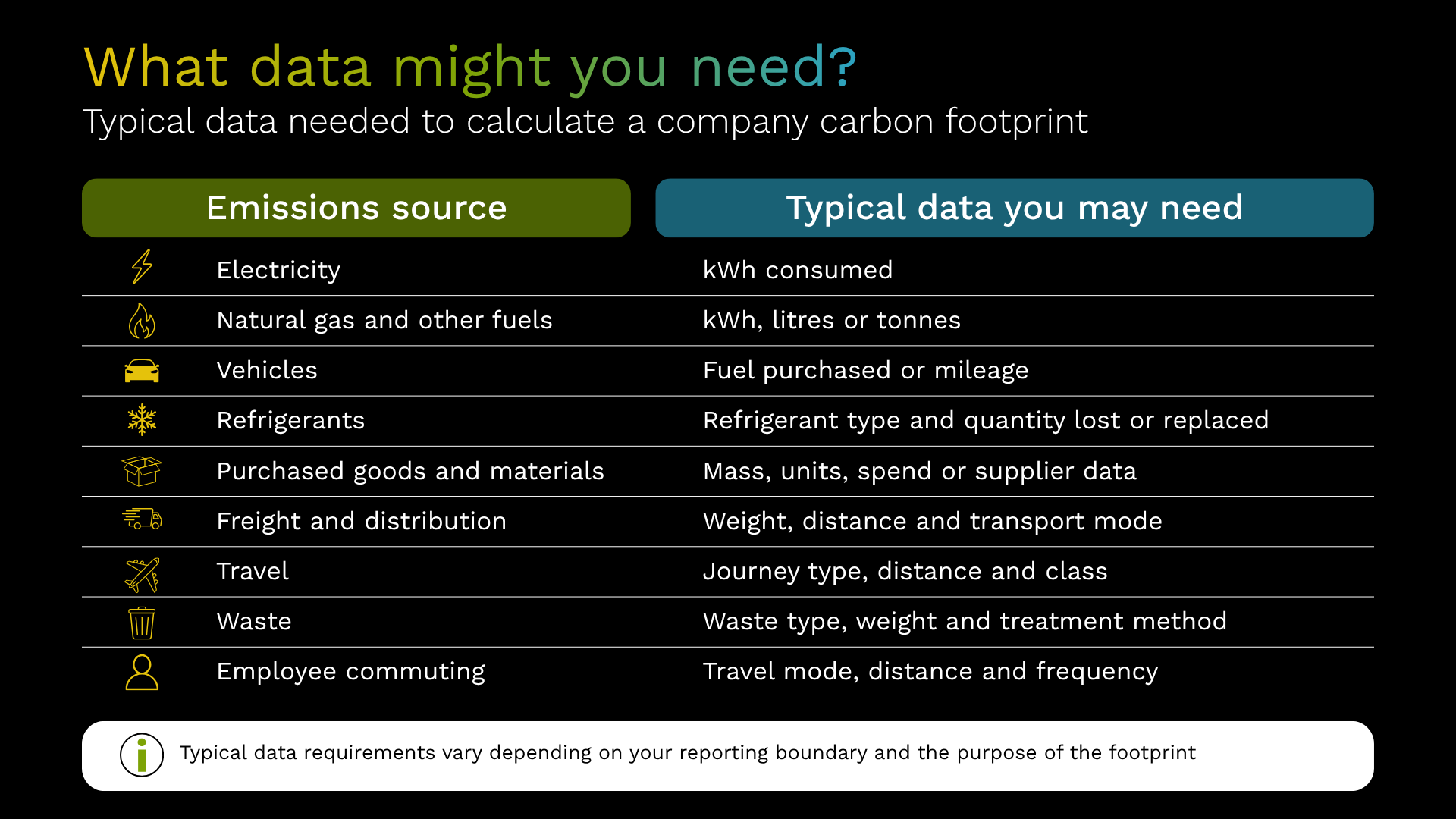
The data you need will depend on how your business operates and what you’ve included in the reporting boundary.
A manufacturer, office-based consultancy and logistics company will not have the same emissions profile. The aim is to identify the data that reflects how your business actually operates.
Where can you find the data?
The information you need is unlikely to be held in one place. Depending on how your business is organised, you may need to speak to several teams.
- Finance may hold energy invoices, fuel spend and purchasing data.
- Facilities may have electricity, gas and refrigerant records.
- Fleet or operations teams may hold mileage and fuel consumption.
- Procurement may have information on materials and suppliers.
- Travel systems may provide flights, rail and hotel data.
- HR may be needed for commuting information.
For Scope 3, you may also need information from suppliers or external datasets. Knowing who owns the data is often just as important as knowing which number you need.
Do you need primary data for everything?
The short answer is no. Reliable activity data (primary data) is generally preferable where it is available, particularly for significant emissions sources. However, you won’t always have detailed primary data for everything and many first carbon footprints contain a mixture of:
- Primary operational data;
- Supplier information;
- Spend data;
- Industry averages;
- Secondary datasets;
- Documented estimates.
For example, you may have accurate electricity consumption for your own sites but only spend data for some purchased goods. That does not necessarily prevent you from building a useful baseline, provided you understand the limitations of the data, are transparent about them, and use an appropriate calculation method.
For many organisations, a small number of activities account for the majority of emissions. Identifying these hotspots early often delivers more value than spending significant time improving low-impact datasetsThe important thing is to understand where estimates have been used and whether better data would materially change the result.
What if some data is missing?
Missing data is common, particularly when you calculate a company carbon footprint for the first time. Do not automatically stop the exercise because a dataset is incomplete.
First ask: How important is the missing information likely to be?
If a source is expected to represent a very small share of total emissions, a reasonable estimate may be sufficient initially. If it could represent one of your largest emissions sources, improving the data becomes much more important.
Document any assumptions or estimates clearly so you can review and improve the calculation over time. Your carbon footprint is more useful when you understand how reliable the figures are and where uncertainty could affect the result.
How accurate does the data need to be?
The level of data required often depends less on the calculation itself and more on how the result will be used. Information suitable for an internal baseline may not be sufficient for customer reporting, target setting or formal disclosure requirements.
An initial internal baseline may rely more on estimates. But if you’re sharing emissions data with a customer, including it in a tender or reporting under a specific framework, you may need stronger evidence and a clearly defined methodology.
Ask yourself: Is the data reliable enough for the purpose you need the carbon footprint to serve? Getting this clear at the start can help you avoid collecting information you don’t need, while making sure you don’t overlook data that really matters.
Do you need to collect all Scope 3 data at once?
Usually not. Scope 3 can include a large number of upstream and downstream activities.
Trying to gather detailed primary data for every category from day one can consume a great deal of time without necessarily improving the parts of your footprint that matter most. A better starting point is often to screen the relevant Scope 3 categories and identify which activities are likely to account for the largest share of your emissions.
Detailed data collection can then focus on the areas that are most material. If Scope 3 is a significant part of your footprint, our guide to Scope 3 emissions reporting explains how to decide what needs a more detailed assessment.
Before you calculate, check the dataset
Once you’ve collected the data, do a basic quality check. Look for:
- Missing sites or reporting periods;
- Duplicate invoices or records;
- Inconsistent units;
- Gaps between financial and operational datasets;
- Significant changes from one year to another;
- Estimates that need to be documented;
- Data that falls outside the agreed boundary.
You don’t need to carry out a complex audit at this stage. You just need to check that the data covers the business and activities you’ve agreed to include, and the reporting period you’ve chosen.
What happens after the carbon footprint is calculated?
Once you have a reliable baseline, the question changes.
You are no longer asking: Where are our emissions coming from?
You can start asking: Which sources account for the most emissions and what can you realistically do to reduce them?
That is where carbon reduction planning begins. Our guide to building a practical carbon reduction plan explains how to move from the footprint to priorities and action.
How Aria can help
You do not need to arrive with a perfect dataset before you get started. Aria can help you define the right reporting boundary, identify what data you actually need and understand where to find that information within your business.
Where data is incomplete, we can help you decide what can reasonably be estimated and where better information is worth pursuing.
The aim is to build a carbon footprint that is credible, transparent and useful for what you need to do next.